What earthwork balance actually saves you
Cut and fill balance is the single largest cost lever on most grading projects, and it is decided during design, not during construction. How the balance is found, what breaks it, and why the savings are larger than the earthwork line item suggests.
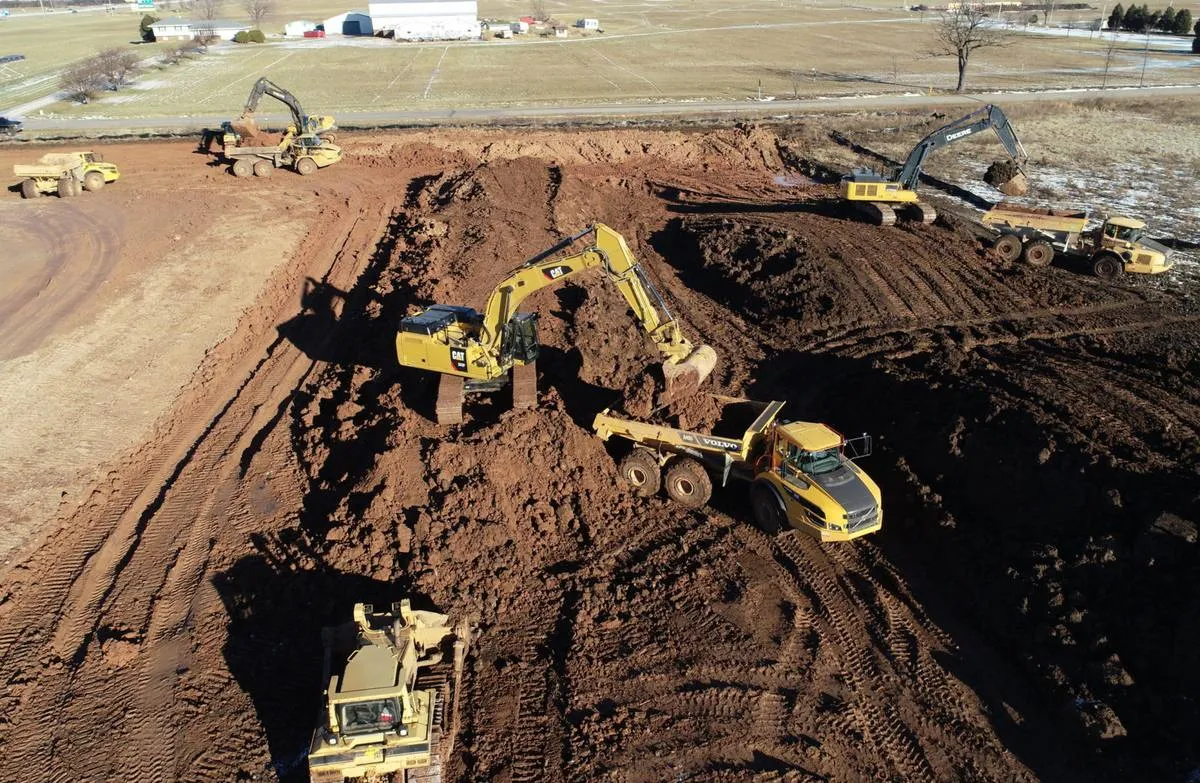
Earthwork balance means the volume of material cut from the high areas of a site equals the volume needed to fill the low areas. When a site balances, nothing has to be trucked in and nothing has to be trucked out.
That sounds like a narrow technical goal. In cost terms it is usually the largest single decision made during grading design.
Why the number is bigger than it looks
The obvious cost of imported fill is the material itself. The costs that sit behind it are larger:
- Haul. Import and export are priced by the load over a distance. On a site needing tens of thousands of cubic metres, haul dominates the material cost.
- Truck traffic. Every load is a truck movement through the surrounding road network, which carries its own traffic management, road maintenance liability, and in some municipalities a haul route approval.
- Schedule. Import is rate-limited by how fast trucks can cycle. A site that balances moves material with scrapers or an excavator-and-articulated-truck spread working inside its own boundary, which is far faster.
- Risk. Imported fill has to be sourced, tested and accepted. Material that fails testing at the gate is a schedule problem discovered at the worst moment.
Export carries the mirror image of these costs, plus a disposal site that has to accept the material.
How the balance is found
Balance is not something you check at the end of design. It is something the design is steered toward from the first grading iteration.
The starting point is a surface comparison: a digital terrain model of the existing ground, built from the topographic survey, and a proposed design surface. The volumetric difference between them gives cut and fill. Areas where the existing ground sits above the design surface are cut; areas below are fill.
The levers available to move that number are, roughly in order of how much they shift it:
- Overall site elevation. Raising or lowering the whole design surface trades cut for fill directly. This is usually constrained at the edges by the tie-in to existing roads, adjacent properties and the servicing invert elevations.
- Pad and lot elevations. Individual building pads and lot grades can often move within a range that does not affect the architecture or the drainage.
- Road profiles. Vertical alignment has grade limits and sight distance requirements, but there is normally room to move within them.
- Grade breaks and slope treatment. Where the design surface transitions between areas, the slope chosen affects volume across the whole transition.
Each of these is bounded by something real — drainage has to work, slopes have to be stable and mowable, the site has to tie into its surroundings, and accessibility requirements constrain running slopes on pedestrian routes. Balance is found inside those constraints, not by ignoring them.
Mass haul: balance is necessary but not sufficient
A site can balance in total volume and still cost a great deal to move, because the cut and the fill are in the wrong places relative to each other. Cutting the north end of a long site to fill the south end means hauling every cubic metre the full length of the site.
Mass haul analysis addresses this. It plots cumulative volume along a haul axis, so the diagram shows not just whether the volumes balance but how far material has to travel to balance them. The area under the mass haul curve is proportional to the haul effort. Two designs with identical total cut and fill can have very different areas under the curve.
This is also where free haul and overhaul distances matter: most earthwork contracts price movement within a certain distance as part of the base rate, and movement beyond it separately. A design that keeps material movement inside the free haul distance is cheaper than one that balances but moves everything twice that far.
What breaks a balance
Three things break a balance that looked fine in the model.
Material suitability. Not all cut is usable as fill. Topsoil has to be stripped and stockpiled. Organic material, soft clays and deleterious material may not be acceptable as structural fill. If a meaningful fraction of the cut cannot be placed, the site no longer balances — it needs import for the shortfall and disposal for the rejected material. This is a geotechnical question, and the answer belongs in the design assumptions before the balance is claimed.
Shrink and swell. Material does not occupy the same volume in the ground, in the truck, and compacted in the fill. Cohesive soils typically compact to less volume than they occupied in situ; some materials swell. The factor is material-specific and comes from the geotechnical report. A balance computed on bank volume without applying a shrinkage factor will be short.
Late layout changes. Moving a building after the grading is set, or adding a structure that requires over-excavation, changes the volumes. This is the most common reason a balanced design arrives on site unbalanced, and it is also the most avoidable.
Getting it right is a design-phase decision
The window for earthwork optimization closes when the site layout is fixed. Once building footprints, road alignments and servicing inverts are locked, most of the levers listed above are gone.
That is the argument for bringing grading into the site planning conversation rather than treating it as something that happens after the layout is complete. The layout that maximises lot yield and the layout that balances earthwork are not always the same layout, and the trade-off between them is worth making deliberately — with both numbers on the table — rather than discovering it after the fact.