Why submissions come back, and how to stop it
Most review comments are predictable, and most of them are about completeness rather than engineering. What reviewers are checking, the deficiencies that recur, and why a pre-application conversation is the cheapest schedule insurance available.
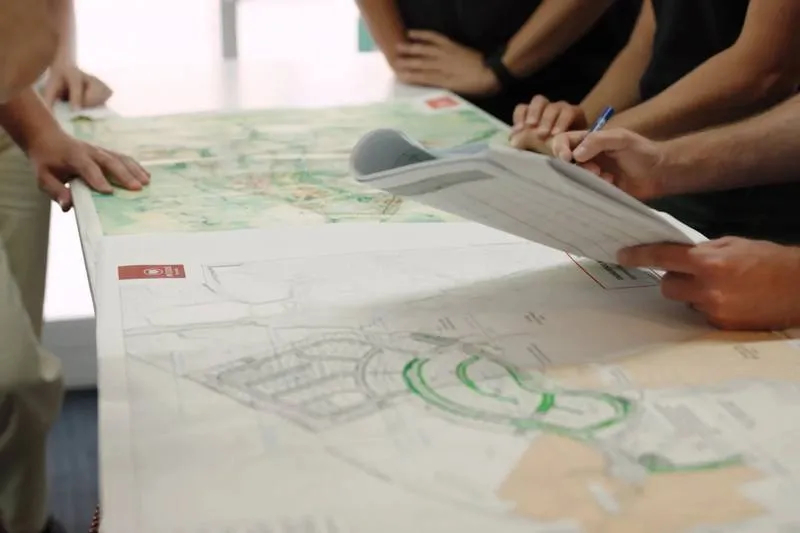
A municipal review cycle is measured in weeks. Two or three cycles is a meaningful portion of a development schedule, and each one is a period where nothing downstream can proceed.
The useful observation is that the comments causing those cycles are largely predictable. They cluster.
What a reviewer is actually doing
A reviewer is checking that the submission demonstrates compliance with the municipality’s standards, that it is internally consistent, and that it is complete enough to be assessed at all.
That last point drives more returns than engineering disagreement does. A reviewer who cannot find the basis for a number cannot approve it, and the fastest available response is to ask for it. From the outside this reads as a rejection on the merits. Usually it is a request for information that was in the engineer’s file but not in the submission.
The deficiencies that recur
Design criteria not stated. The submission uses a runoff coefficient, a design storm, a rainfall dataset, a roughness value. Where did each come from? If the criteria are not stated, every downstream number is unverifiable.
Pre- and post-development comparison not like for like. The controlled quantity is the difference between two modelled conditions. If the two are modelled with different catchment boundaries, different methods, or different assumptions about what existed before, the difference is not meaningful. Reviewers check this specifically.
Catchment boundaries that do not account for external drainage. Water arriving from upslope of the site is part of the system whether or not it is in the model.
Inconsistency between documents. The report says one thing, the drawings show another, the calculations use a third value. This is the single most common consistency comment, and it usually comes from a design revision that propagated into some documents but not all.
Missing or unstated datum and benchmark. Elevations without a stated datum cannot be checked against anything.
Drawings that are not self-consistent. Grades that do not close, spot elevations that disagree with contours, sections that do not match the plan, details referenced but not included.
Outlet and overflow not addressed. Detention designs that establish the storage volume but do not demonstrate the release rate at each stage, or that do not show what happens in an event exceeding the design storm.
Erosion and sediment control treated as a formality. ESC plans that show a silt fence around the perimeter and nothing about construction sequencing, stockpile management, dewatering or stabilisation are routinely returned.
Servicing conflicts. Proposed utilities that clash with each other, with existing infrastructure, or with the grading — most often at crossings, where required separation is not demonstrated.
The pre-application conversation
The highest-leverage step available is a conversation with the reviewing authority before the design is finalised — on the approach, the design criteria, the submission contents, and anything about the site that is unusual.
It is inexpensive. It takes a meeting. And it converts the most expensive category of comment — a fundamental disagreement about approach, discovered after the design is complete — into a design input.
It is particularly worth doing when:
- the site has an unusual constraint, or discharges somewhere unusual
- you intend to use an approach the standard does not explicitly contemplate
- the site straddles a jurisdictional boundary, or drains into another jurisdiction
- the project is on a schedule that cannot absorb a second cycle
Alberta and British Columbia are not interchangeable
Both provinces have provincial legislation governing water and land development, and both delegate a great deal to the municipality. The practical consequence is the same in both: the governing requirements are the local ones, and they differ between neighbouring municipalities within the same province.
A design approach that was approved in one municipality is evidence that the approach is sound. It is not evidence that it complies with the standard next door. Beyond the municipal layer, provincial approvals may be triggered by works affecting a watercourse, by the volume of water diverted, or by the nature of the development — and the applicable triggers, thresholds and processes differ between the two provinces.
The working assumption that holds up is: confirm the governing standard for the specific site, in the specific municipality, at the start of every project, and do not carry assumptions across a boundary.
Building the submission to be reviewed
A submission that is easy to review gets reviewed faster. In practice:
- State the criteria up front, with their sources, in one place.
- Show the calculation, not only the result.
- Make the documents agree. Before issuing, check the report, drawings and calculations against each other for the values that appear in more than one.
- Include what the checklist asks for, in the order it asks for it, where the municipality publishes one.
- Address the known issues explicitly. If something about the site is unusual, explain it in the submission rather than leaving the reviewer to discover it.
- Respond to comments completely. A response that addresses four of five comments guarantees another cycle.
None of this is engineering. It is the difference between one review cycle and three.
Requirements vary by municipality and by province, and they change. Confirm the governing standards and approval triggers for your specific site and jurisdiction at the start of the project.